


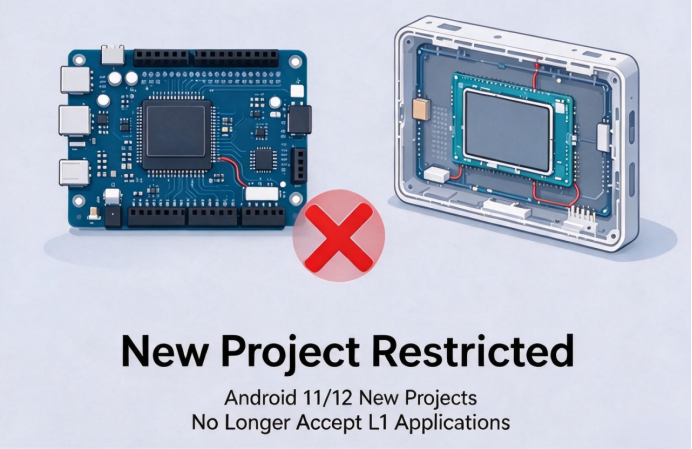
Android hardware projects developed for Android 11 or Android 12 that have not yet obtained Google Widevine L1 certification can no longer apply for Widevine L1 certification.
In accordance with the latest policy adjustments to Google Widevine, Google has officially ceased accepting new Widevine L1 DRM certification applications for Android 11, Android 12, and earlier system versions; the minimum system version currently eligible for application is Android 13. These adjustments apply to three major platforms: AOSP, GAS (Google Automotive Services), and AAOS (Google's open-source automotive operating system).
1、Changes: Which areas will be affected and which will remain unchanged
The core objective of this policy adjustment is to close the application pathway for new projects; it will not impose retrospective restrictions on existing equipment that has already completed certification.
Devices already on the market will not be affected by policy changes. Android 11/12 devices that have completed Google Widevine L1 certification and are currently available for purchase can continue to use the corresponding eGoogle Widevine L1 service normally; users' high-definition streaming media playback experience will remain unchanged.
Projects subject to policy constraints are primarily divided into two categories:
1) The first category comprises new hardware projects developed for Android 11/12 and planned to obtain Google Widevine L1 high-definition playback permissions;
2) The second category comprises ongoing projects whose hardware development is essentially complete but which have not yet been submitted, or which have not yet passed the final Google WV‑CTS/VTS testing and acceptance process. Put simply, if a device has not completed the full Google Widevine L1 certification process and the system version is Android 11 or 12, it will no longer be eligible for Widevine L1 certification.
2、The Core Value of Google Widevine L1
Widevine classifies decryption operations into three security levels: L1, L2, and L3.
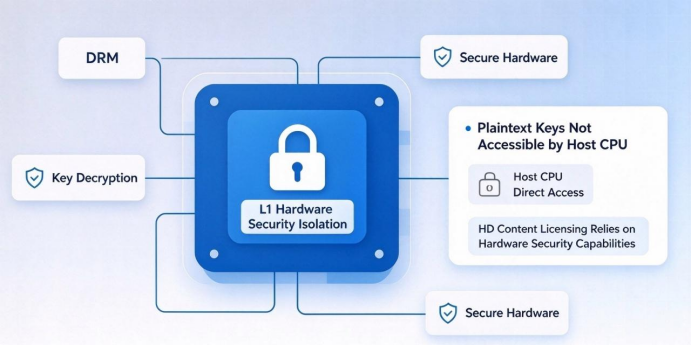
At the L1 level, decryption and video processing must be carried out within a trusted execution environment (TEE) or dedicated security hardware, preventing the main processor from accessing plaintext keys; at the L3 level, the solution is purely software-based, with keys processed in ordinary memory. Content providers tie the playback rights for high-definition and even 4K source material to the L1 level, relying precisely on the trust provided by this hardware-level isolation.
Platforms such as Netflix typically offer HD and 4K playback only to devices that have completed Widevine L1 certification. Even if a device has achieved Widevine L3 certification, its screen specifications may still be limited to standard-definition quality on these platforms. For tablets, TV boxes, or in-car systems designed for audio-visual entertainment, achieving Widevine L1 certification provides a stronger competitive edge in the market.
3、Hard requirements for Widevine L1-certified front-end hardware
It should be noted that upgrading to Android 13 merely provides the basic eligibility to submit a certification request. Widevine L1 certification imposes additional, independent prerequisites at the hardware level: the SoC main control chip must be included in Google's compliance list; the device must incorporate a TEE or an independent security unit; and the OEMCrypto version must likewise comply with the relevant specifications. If the chip platform itself has not completed adaptation to Android 13 or a later version, simply upgrading the system version will not automatically grant eligibility to apply for Google Widevine L1 certification.
It is recommended that enterprises first assess the chip platform's compatibility with Android 13 and later versions before switching to a new system version; once they have confirmed that the underlying hardware fully meets the mandatory Widevine L1 requirements, they should then initiate the subsequent certification process.
4、Real-world impact on hardware manufacturers
For hardware R&D teams with longer product planning cycles, this policy change means that the lifecycle of Android 11 and Android 12 as carriers for Google Widevine L1 certification has come to an end. New projects that continue to be developed based on these two versions should, if they target overseas markets with demand for high-definition streaming playback, promptly assess the feasibility of migrating to Android 13 or later, or reconsider their product image-quality positioning and target markets.
Full Google Widevine L1 certification encompasses the entire process—from hardware and software to testing. When creating a timeline, manufacturers should incorporate both the certification cycle and the engineering costs associated with migrating to the new system version into their planning.
Tel: 13417442373(Wechat)
E-mail: finny.zhou@zhongletest.com
Teams:nancy.le@zhongletest.com