

Due to its user-friendly experience, wireless charging has been widely adopted in fields such as consumer electronics and automotive accessories. However, beneath the apparent convenience of "charge-on-demand," latent risks—including overheating, ignition by foreign objects, and signal interference—can easily go unnoticed. To achieve stable and reliable wireless charging, Qi certification serves as an indispensable core safeguard for any product.
I. Being rechargeable does not equate to safe charging.
Wireless charging has now become widely adopted; however, there remains a significant gap between its availability and its ability to deliver powered, safe, and stable charging. Chargers that have not passed Qi certification are not inherently unusable, but rather pose latent safety risks. WPC cited data from an independent laboratory: when a coin—simulating a foreign object—was placed between the charger and a smartphone, the surface temperature of non-certified products rose to 96.1 °C within 51 seconds, which could cause third-degree burns. The primary purpose of Qi certification is to mitigate such safety hazards.
II. Qi Certification: Interoperability Standard for Wireless Charging Devices
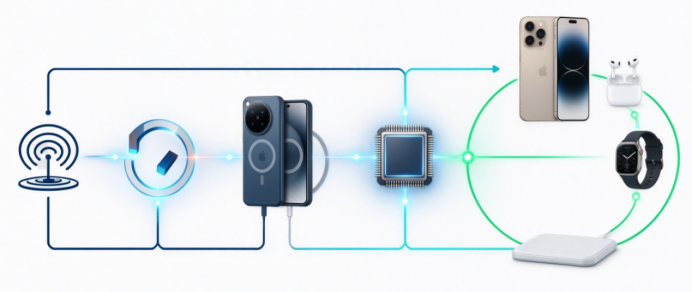
Qi is defined by the Wireless Power Consortium (WPC) and serves as the globally adopted wireless charging standard.
l Qi 1 (BPP/EPP): Starting at 5W, later upgradable to 15W; uses traditional coil alignment, no magnetic adhesion;
l Qi 2.0 (2023): Introduces MPP magnetic alignment, 15W power output, automatic alignment, and reduced offset heating;
l Qi 2.1 (2024): Introduces "Qi2 Ready" support, enabling MPP functionality for non-magnetic phones when paired with a magnetic case; adds a mobile coil solution to optimize in-vehicle charging.
l Qi 2.2 (end of 2024): maximum power increased to 25 W, with enhanced thermal management ensuring that the surface temperature under high power operation remains ≤40 °C. In 2025, Qi v2.0 was adopted by IEC as an international standard (IEC 63563).
In short, Qi is an interoperability protocol for charging devices from different brands. Products must pass a full suite of tests conducted by a WPC-certified laboratory to legally bear the Qi logo.
III. Four Major Risks Associated with Products Lacking Qi Certification
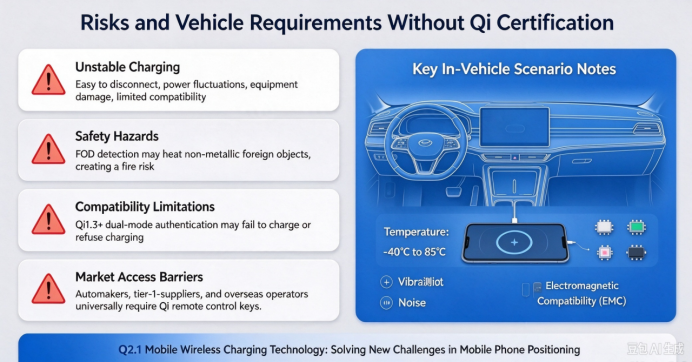
1. Unstable charging: prone to power interruptions, power fluctuations, and device errors. Qi-certified products have undergone interoperability verification; non-certified products exhibit poor compatibility, and only a few devices can barely function.
2. High safety risks: Foreign Object Detection (FOD) is the core safety mechanism, which immediately cuts off power upon detecting metallic foreign objects. If uncertified products continue to heat metal components, there is a risk of ignition; inadequate temperature control can also accelerate battery degradation.
3. Limited compatibility: Incomplete support for smartphones and earphones; slow charging is often the only option. Qi 1.3 and later versions support bidirectional authentication; unauthenticated chargers may be limited in power output or even denied charging access by the device.
4. Barriers to market access: E-commerce platforms, automotive OEMs,and overseas supermarkets commonly require Qi certification; without such certification, products cannot be listed for sale.
Key considerations for in-vehicle applications: vehicle cabin vibrations, significant temperature fluctuations, and the presence of various sensitive electronic components within the vehicle. Qi-certified products must pass temperature cycling tests ranging from-40 °C to 85 °C, as well as vibration tests; furthermore, they must not cause electromagnetic interference (EMC) to in-vehicle systems. WPC testing has shown that in half of the test vehicles, the use of uncertified in-vehicle wireless charging led to interference with remote key signals, resulting in failure. The Qi 2.1 mobile coil technology is specifically designed to address the issue of intermittent charging when mobile phones are moved during vehicle operation.
IV. One-Stop Qi Certification Service Partner
Zhongle Certification provides end-to-end one-stop services for Qi certification, encompassing WPC member registration, product registration, delivery to ATL for compliance testing, IOC interoperability verification, and ultimately WPC certification issuance. Leveraging extensive experience in automotive wireless charging projects, Zhongle Certification offers pre-testing and technical rectification guidance, thereby enhancing the first-pass rate and shortening the certification cycle.
Tel: 13417442373(Wechat)
E-mail: finny.zhou@zhongletest.com
Teams:nancy.le@zhongletest.com