

In the car play certification audio testing suite, "Siri Audio Quality" and "Enhanced Siri Audio Quality" are often confused, yet their intended purposes are entirely different. The former is a mandatory baseline test that all CarPlay products must pass, while the latter is an advanced test introduced by Apple to enhance the voice interaction experience.
I. Siri audio quality: A mandatory basic test item
The "Audio Quality Test" is a standard item in the list of carplay certification test items, alongside the "ITU-T Telephone Audio Quality Test"; separate tests are required for wired and wireless connectivity modes.
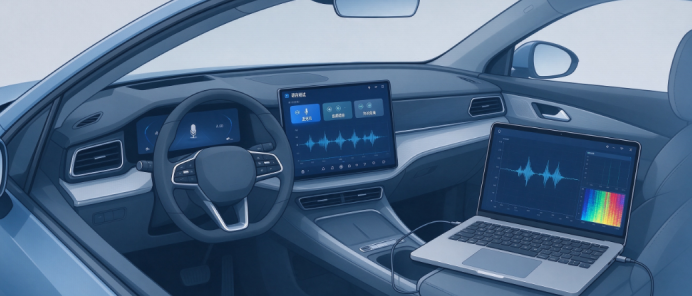
The primary objective of this test is to verify whether the audio capture capability of the in-vehicle infotainment system can ensure Siri's recognition accuracy and normal response performance. The test employs Apple's dedicated testing tool to play standard voice signals, perform audio recording and analysis, and evaluate the audio capture performance of the in-vehicle microphone under various operating conditions. Particular focus is placed on the upstream audio path: the signal quality of voice captured by the in-vehicle microphone, processed via audio processing, and then transmitted to Siri's engine on the iPhone.
The audio streaming requirements for Siri are more stringent than those for standard voice calls; this necessitates that in-vehicle systems be equipped with higher-performance microphone arrays and noise-reduction solutions to ensure the signal quality required for speech recognition under in-vehicle noise conditions. At the same time, Apple's specifications explicitly prohibit the use of single-channel noise-reduction algorithms—such as spectral subtraction—as well as automatic gain control and residual echo suppression, as these techniques can degrade speech recognition accuracy.
II. Enhanced Siri: Why You Need an Enhanced Version of Siri
The Enhanced Siri concept originated from the 2020 carplay R16 specification and was formally incorporated into the mandatory certification scope in 2022.
The basic Siri solution has inherent limitations: keyword wake-up recognition is entirely handled by the iPhone, while the vehicle infotainment system merely forwards audio data, making it impossible to perform targeted optimizations based on the acoustic environment of the actual vehicle interior.
The enhanced Siri has adjusted its operational logic: Apple has delegated front-end wake-up recognition permissions to the in-vehicle infotainment system. The infotainment system can leverage its own hardware and software, along with a local speech model, to perform keyword wake-up detection and speech activity detection, then transmit the valid speech data to the iPhone for processing. The infotainment system no longer merely serves as an audio forwarding channel; it must now possess local speech processing capabilities.
Domestic vehicle models must pass the Chinese-language version of the Enhanced Siri test and be capable of integrating Chinese voice models provided by vendors such as Baidu and iFLYTEK.
III. Key Differences Between the Two
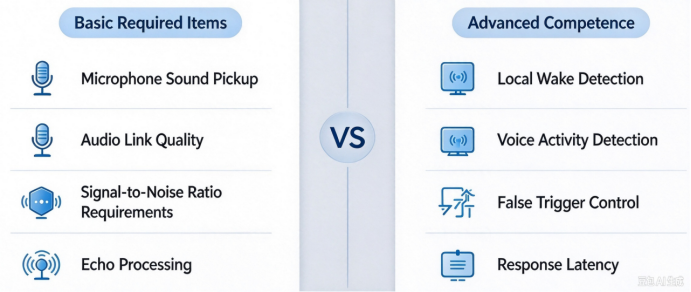
1. Different test subjects: "Siri Audio Quality" evaluates the quality of the audio chain—including basic acoustic metrics such as microphone audio performance, echo suppression, and signal-to-noise ratio. "Enhanced Siri Audio Quality" assesses the capabilities of the speech recognition front-end—specifically the accuracy of local wake-up detection, false trigger rate, and response latency.
2. Different permission ownership: For the basic Siri, wake-up recognition is performed on the iPhone, while the vehicle infotainment system merely serves as a "relay." For Enhanced Siri, the wake-up permission is delegated to the vehicle infotainment system, which must independently perform keyword detection and voice activity detection.
Ⅳ. Preparation Recommendations
Regardless of which test is being conducted, a pre-test is essential. Industry experience shows that thorough pre-testing can identify approximately 80% of potential audio issues in advance, thereby avoiding the high re-testing costs associated with formal submissions.
For Enhanced Siri, it is recommended to define the technical solution for the Chinese speech model during the early stages of development, and to conduct targeted tuning based on the acoustic environment of the target vehicle model. The testing requirements for the in-vehicle test environment and the audio processing chain are significantly higher than those for Basic Siri; therefore, adequate resources should be reserved during both hardware selection and software optimization phases.
Tel: 13417442373(Wechat)
E-mail: finny.zhou@zhongletest.com
Teams:nancy.le@zhongletest.com