




The rapid adoption of intelligent and electrified vehicles has led to increasingly complex onboard electronic and electrical systems as well as software algorithms, shifting safety risks from traditional mechanical failures to systemic failures of hardware and software. As the globally recognized functional safety standard for the automotive industry, ISO 26262 has become a critical requirement for vehicle manufacturers to comply with regulations and access the high-end supply chains of original equipment manufacturers (OEMs).

Ⅰ. Standard Traceability: Understanding the Core Framework of ISO 26262 for Automotive Functional Safety
ISO 26262 is an international standard for electrical and electronic functional safety specifically designed for road vehicles, derived from the general industrial safety standard IEC 61508. The current mainstream version is the 2018 edition, which corresponds to China's national standard GB/T 34590 and applies universally across all automotive applications.
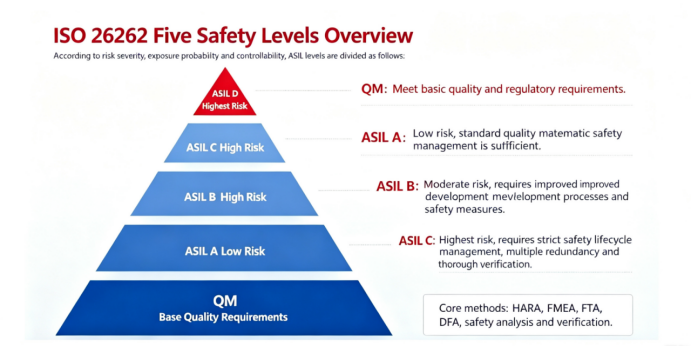
The core of the standard lies in comprehensive lifecycle safety management coupled with ASIL level classification, covering risk control throughout the entire product lifecycle—from conceptual design and development testing to mass production, operation, maintenance, and final disposal. Safety levels are divided into five grades: QM, A, B, C, and D, with ASIL D being the highest grade, applicable to critical safety components such as steering systems, airbags, and autonomous driving control systems; higher levels entail stricter requirements for development processes, validation testing, and risk management.
II. Industry Essential Requirement: The Core Value of Automotive Companies Implementing ISO 26262 Certification
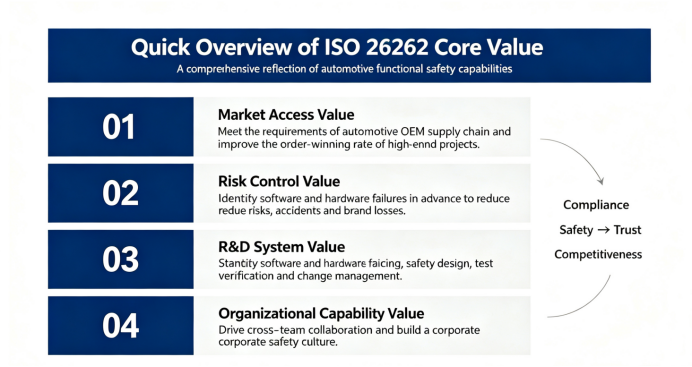
Today, ISO 26262 certification is no longer merely a competitive advantage but has become an essential requirement for automotive manufacturers, with its core value centered on three key aspects:
First, market access is a fundamental requirement. In supply chain bidding processes for major automakers and new energy vehicle manufacturers, ISO 26262 certification serves as a mandatory threshold; failure to obtain this certification prevents entry into high-end supply chains, thereby directly limiting companies' order acquisition capacity and market potential.
Second, mitigate operational risks. The standard system enables proactive risk prevention by employing professional fault analysis, demand traceability, and closed-loop validation to reduce product failure probability at the source, thereby effectively avoiding high-cost risks such as product recalls, safety incidents, and brand damage.
Third, enhance corporate capabilities. Implementation of certification standardizes processes for R&D, testing, quality control, and cross-departmental collaboration, eliminates crude development practices, improves product stability and R&D efficiency, and strengthens the company's core competitiveness.
III. Practical Implementation: Overview of the Complete Process and Cycle for ISO 26262 Certification
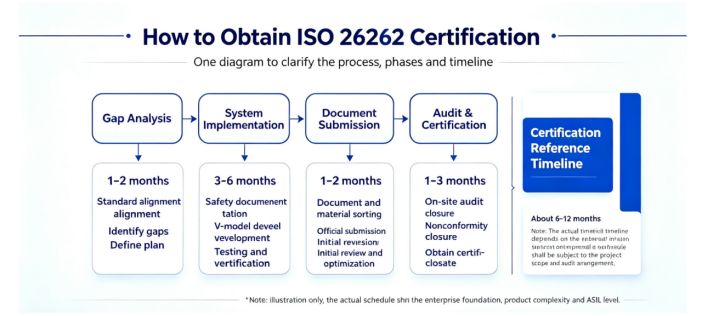
The certification process consists of four core steps, with duration varying according to the product's ASIL level: approximately 6–9 months for standard-grade projects and over 12 months for high-level ASIL C/D projects.
1. Gap diagnosis and plan formulation: Identify deficiencies in the enterprise's existing systems against established benchmarks, establish a dedicated safety team, equip it with comprehensive toolkits, and develop a tailored implementation roadmap.
2. System Development and Pilot Operation: Complete the full set of safety documentation, conduct risk assessment, safety design, and software/hardware testing according to the V-model, and establish end-to-end traceability with closed-loop corrective actions.
3. Document Submission and Preliminary Review Rectification: Organize the review materials and submit them to the designated institution, completing the rectification and optimization of issues identified during the preliminary review.
4. On-site Audit and Certification Issuance: After passing the two-stage on-site audit conducted by the authority, the certification certificate will be issued upon successful verification. Subsequent annual supervisory audits are required to maintain the validity of the qualification.
IV. Industrial Empowerment: The Long-Term Significance of Automotive Companies' Focus on Functional Safety
Amid the rapid evolution of intelligent connected vehicles, ISO 26262 certification has evolved far beyond mere compliance verification to become a core strategic enabler for sustainable corporate development. For the automotive industry, a standardized functional safety framework enables the sector to transition from extensive R&D and production approaches, unify software and hardware security standards, significantly mitigate systemic safety risks in vehicles, and drive the intelligent and standardized transformation of the automotive industry.
For enterprises themselves, establishing a compliant safety system is not only crucial for fulfilling their social responsibility in driving safety and enhancing brand credibility, but also enables them to build differentiated competitive advantages. Amid increasingly stringent industry regulations and market competition, a research and development framework centered on functional safety allows companies to consistently meet the demands of high-end projects, deepen their integration into OEM supply chains, and achieve sustainable, high-quality growth.
V. Professional Support: Zhongle Certification Empowers Enterprises to Achieve Efficient Customs Clearance and Sustainable Development
To address common challenges faced by automotive enterprises during certification processes—including high investment costs, limited technical expertise, poor cross-departmental collaboration, and unpredictable timelines—Zhongle Certification specializes in automotive functional safety certification. Our team comprises experienced certified instructors who provide comprehensive guidance throughout the entire process. Leveraging extensive practical experience in automotive certification, these experts meticulously explain standard requirements, break down certification procedures, and guide the establishment of certification frameworks and technical implementation. They tailor certification strategies based on an enterprise's organizational size, product characteristics, and specific project needs, offering full support from system development and technical challenges to issue resolution, documentation preparation, and on-site audits. This approach effectively avoids common certification pitfalls, significantly reduces learning and trial-and-error costs, and enables companies to obtain certifications efficiently and compliantly, thereby rapidly gaining access to premium automotive supply chain opportunities.
Tel: 13417442373(Wechat)
E-mail: finny.zhou@zhongletest.com
Teams:nancy.le@zhongletest.com