

Hello, dear customers,
Recently, the Federal Communications Commission (FCC) approved a new rule proposal (Case No.24-136) aimed at tightening the accreditation policies for overseas electronic device testing laboratories. This undoubtedly serves as a critical signal requiring close attention for companies currently exporting or planning to export electronic products to the U.S. market.
Zhongle Certification promptly summarized the key points of the new regulations and compiled three major changes, two preparatory measures, and one recommendation to assist you in proactive planning and risk mitigation.

1、Three Major Changes: What Does the FCC Plan to Do?
1. Proposal to prohibit test results from laboratories in "non-reciprocal countries"
The FCC proposes: to no longer recognize testing laboratories and certification bodies from countries that have not entered into Mutual Recognition Agreements (MRAs) or similar reciprocal trade agreements with the United States.
In other words, if the country where a laboratory is located does not mutually recognize testing and certification results with the United States, the test reports issued by that laboratory may no longer be recognized by the FCC in the future.
The most significant impact is felt by laboratories in countries that have not yet signed the MRA with the United States.
2. A two-year transition period for the gradual phase-out of non-compliant laboratories
The proposal specifies that upon the final rules taking effect, a two-year transition period will be established to gradually phase out laboratories that do not meet the reciprocity requirements.
This means: If the laboratory you are currently using is located in a non-reciprocal country, you have approximately two years to make adjustments and switch.
3. Prioritize the approval of equipment for "Trusted Laboratory" testing
The most significant impact is felt by laboratories in countries that have not yet signed the MRA with the United States.
2. A two-year transition period for the gradual phase-out of non-compliant laboratories
The proposal specifies that upon the final rules taking effect, a two-year transition period will be established to gradually phase out laboratories that do not meet the reciprocity requirements.
This means: If the laboratory you are currently using is located in a non-reciprocal country, you have approximately two years to make adjustments and switch.
3. Prioritize the approval of equipment for "Trusted Laboratory" testing
The FCC also issued a new order:
Equipment tested by "trustworthy laboratories" within the United States or in reciprocal countries (such as those with an MRA agreement with the U.S.) will enter the priority review process.
Conversely, reviews for other paths may become slower and stricter.
1、The actual impact on businesses
ü In the short term:
ü If you have been using laboratories located in the United States or in countries with a MRA agreement with the U.S. (such as the European Union, Japan, South Korea, the United Kingdom, etc.), the current impact is minimal; in fact, the priority review process may even accelerate the certification process.
v In the medium to long term:
v If you currently rely on laboratories in non-reciprocal countries (including certain nations in Southeast Asia, the Middle East, and Eastern Europe that have not signed MRA agreements with the United States), you face the following challenges:
1. The test report may be rejected in the future.
2. The product cannot obtain FCC authorization.
3. Export to the United States is being blocked.
2、Two preparations: Zhongle Certification recommends you take immediate action.
✅ Preparation 1: Inventory the currently used laboratories
Please use the table below for judgment:
Zhongle Certification can help you quickly determine
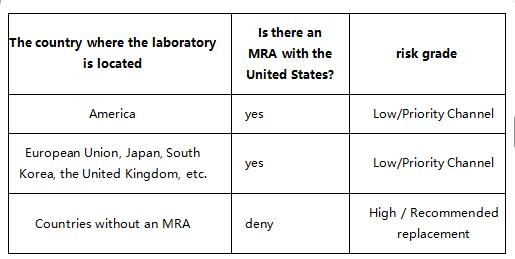
whether existing laboratories are on the "安全 list".
✅ Preparation 2: Plan the switch strategy in advance
It is recommended to gradually transfer the testing tasks to the following during the 2-year transition period:
l A domestic laboratory in the United States
l Or a mutually recognized national laboratory approved by the United States.
Meanwhile, monitor the FCC's subsequent updates to the "List of Reciprocal Countries."
1、A suggestion: Begin planning as early as possible to shift from a passive to an active approach.
1. What are the long-term benefits for businesses?
One of the core objectives of this FCC reform is to streamline the approval process for testing equipment in accredited laboratories.
In other words, once you switch to an FCC-approved "trusted laboratory":
l faster review
l The process is more stable.
l The export risk is lower.
This presents an excellent opportunity for enterprises to optimize their supply chains and enhance certification efficiency.
2. What can Zhongle Certification do for you?
We have been closely monitoring policy changes in international certifications such as FCC, CE, and UL, enabling us to:
l Assess the current compliance risks of your laboratory
l Recommended laboratories are those accredited by the FCC in the United States or reciprocal countries.
l Assist with test transfer and re-certification
l Provide ongoing policy updates and compliance consulting services
Policy changes are not frightening; what's truly alarming is being unprepared. This time, the FCC is adopting a dual approach: tightening regulations while optimizing trusted channels. For companies that act proactively, this isn't an obstacle but rather a window of opportunity to establish a compliance advantage.
If you're unsure whether your current product is affected, please feel free to contact the Zhongle Certification Team. We will provide you with a personalized risk assessment and tailored mitigation plan.
Tel: 13417442373(Wechat)
E-mail: finny.zhou@zhongletest.com
Teams:nancy.le@zhongletest.com