


In the software-defined automotive era, the surge in the number of ECU units and increasingly open in-vehicle interfaces has transformed cyberattacks from potential risks into tangible security threats. Vulnerabilities such as in-vehicle network intrusions, data breaches, ECU tampering, and OTA hijacking directly endanger driving safety and user privacy. The absence of unified cybersecurity engineering standards exposes enterprises to compliance penalties, brand risks, and even elimination from global supply chain competition. As the core standard for automotive cybersecurity, ISO/SAE 21434 has become an essential compliance requirement for automakers and suppliers at all levels.

I. ISO/SAE 21434: A dedicated cybersecurity engineering standard for the automotive industry
ISO/SAE 21434 "Road Vehicles – Cybersecurity Engineering" is the world's first dedicated automotive cybersecurity engineering standard jointly issued by ISO and SAE. Its core principle is to integrate cybersecurity capabilities throughout the entire lifecycle of electronic and electrical systems, rather than relying on post-incident remediation.
· Comprehensive Coverage: Encompassing the entire lifecycle—from concept and development to production, operation and maintenance, and decommissioning—including complete vehicles, components, software, communication interfaces, and cloud services.
· Core Strategy: Built upon the CSMS cybersecurity management system, it employs TARA threat analysis and risk assessment to identify assets, attack vectors, and risk levels, then implements corresponding security measures.
· Core Concept: Security by Design (in-built security), integrating functional security development processes, clarifying security responsibility boundaries across the supply chain, and establishing vulnerability response and continuous monitoring mechanisms.
· Industry Positioning: Complementing ISO 26262 Functional Safety, it forms the dual cornerstone of intelligent vehicle safety and serves as the core implementation basis for mandatory regulations such as UN R155 and GB 44495.
II. Why must the supply chain implement ISO/SAE 21434?
◆ Global regulations mandate compliance with UN R155, which explicitly requires new vehicles to obtain CSMS certification upon market launch, with 21434 being the sole recognized implementation framework; domestically, GB 44495/44496 serves as the comprehensive benchmark, prohibiting non-compliant products from mass production or registration.
◆ Strict supply chain access requirements: Major automakers mandate 21434 as a mandatory criterion for supplier verification. Without a compliant system, companies cannot be included in the designated supplier list or participate in overseas project bidding.
◆ Controllable Risks and Cost Optimization: By conducting proactive risk assessments, organizations can reduce subsequent vulnerability remediation costs, minimize recall incidents, legal disputes, and brand damage, ensuring precise alignment between security investments and risk levels.
◆ A single cross-regional compliance mutual recognition framework simultaneously meets regulatory requirements across the EU, Japan, South Korea, and Southeast Asia, eliminating redundant certifications and shortening market approval timelines.
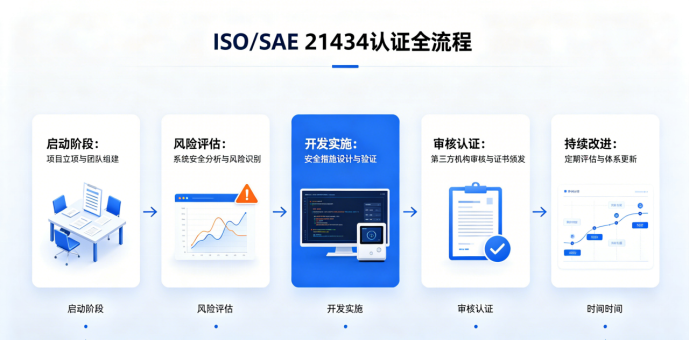
III. The Full Process for Implementing and Certifying ISO/SAE 21434
1. Current status diagnosis and scope definition: Review the product matrix and R&D processes, clearly verify coverage of components/software/vehicle models, complete the gap analysis of standard clauses, and develop a rectification roadmap.
2. System Architecture Development and Documentation Output: Establish an organizational-level cybersecurity policy, develop CSMS procedure documents, TARA operation guidelines, security development specifications, supplier management requirements, and emergency response plans, forming a comprehensive documentation package.
3. The trial operation and project validation system shall be operational for no less than three months. Representative projects shall be selected to complete TARA implementation, safety design, testing verification, and vulnerability closure, with full-process records retained.
4. The certification application is submitted to the selected accreditation body after the initial document review, which verifies the completeness and compliance of the documents and addresses any non-conformities.
5. The two-phase on-site audit team validated the system's operational effectiveness through interviews, sampling inspections, and record tracing, with a focus on verifying TARA implementation, secure development practices, supply chain controls, and vulnerability management.
6. The certificate is issued upon successful certification and continuous monitoring and rectification, with a validity period of 3 years. Annual supervision audits are conducted to continuously optimize the system in accordance with standard updates and product iterations.
IV. Zhongle Certification: A One-Stop Partner for Automotive In-Vehicle Network Security Compliance
Zhongle Certification specializes in automotive in-vehicle electronics certification, focusing on intelligent connected vehicle safety and compliance, and provides comprehensive ISO/SAE 21434 compliance solutions for vehicle manufacturers and component suppliers.
· Standard Implementation Consultation: Customized CSMS framework that integrates functional safety processes, addresses compliance gaps, and ensures first-time audit approval.
· TARA Special Service: Professional services including asset identification, attack analysis, risk assessment, and security requirements mapping, with the issuance of a compliant and audit-ready report.
· Tiered Training Empowerment: Customized training programs for management, R&D, testing, and quality control roles, integrating standards into daily workflows.
· Supply Chain Security Guidance: Establish a supplier security audit mechanism, clarify the responsibilities of upstream and downstream parties, and enhance the overall cybersecurity capabilities of the supply chain.
· Efficient certification integration: Collaborating with internationally recognized authorities to shorten certification cycles, saving enterprises time and labor costs.
epilogue
In the competition for smart vehicles, safety serves as both the baseline and a critical barrier. ISO/SAE 21434 is not merely a compliance certificate but also a core validation of supply chain security capabilities. Leveraging its professional expertise and industry experience, Zhongle Certification supports enterprises throughout the entire process—from system establishment to certified operation—ensuring compliance with smart vehicle cybersecurity standards and enabling products to enter global markets with confidence.
Tel: 13417442373(Wechat)
E-mail: finny.zhou@zhongletest.com
Teams:nancy.le@zhongletest.com